

How to Tell If Coffee Beans Are Stale
Table of Contents
- What Stale Coffee Beans Actually Taste Like
- Signs of Rancid Coffee Beans You Can See and Smell
- The Bloom Test: A Simple Freshness Check
- Coffee Bean Shelf Life After Roasting
- How to Store Coffee Beans for Maximum Freshness
- What to Do With Stale Coffee Beans
- Conclusion
Last Updated: August 29, 2026
What Stale Coffee Beans Actually Taste Like
Knowing how to tell if coffee beans are stale is the single most useful skill a home brewer can develop. At American Brew Coffee, we roast to order precisely because staling is not a gradual inconvenience; it is a rapid, chemistry-driven process that strips everything worth tasting from a bean.
Stale coffee beans are beans that have undergone significant oxidation and off-gassing of aromatic compounds, resulting in a flat, lifeless cup with diminished complexity and distorted flavor.
The most common descriptors are cardboard, hollow, and bitter in an unpleasant, lingering way, not the clean, bright bitterness of a well-extracted espresso, but a dull, papery bitterness that sits on the back of the palate. Acidity disappears almost entirely. Vibrant fruit notes collapse into something muted. A medium roast that once tasted of caramel and hazelnut starts tasting of nothing at all, then eventually of something faintly rancid.
Freshly roasted beans contain hundreds of volatile aromatic compounds responsible for their flavor profile. Once exposed to oxygen, those compounds degrade through oxidation, the fats in the bean go rancid, and the aromatics evaporate. Carbon dioxide, which acts as a natural preservative by displacing oxygen inside the bean, also escapes over time. Once the CO₂ is gone, oxygen moves in, and staling accelerates. A flat taste is the clearest symptom.
Signs of Rancid Coffee Beans You Can See and Smell
The good news: you do not always need to brew a cup to catch stale beans. Visual and aromatic clues are often enough to make the call before you waste the grounds.
Visual Indicators: Surface Oils and Color Changes
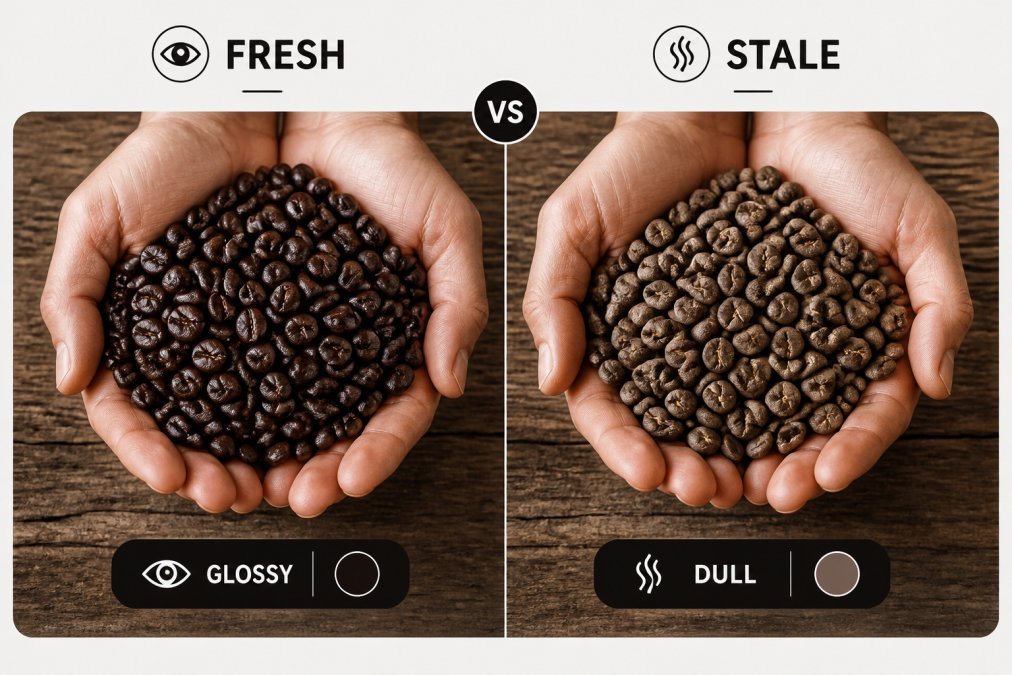
Fresh, recently roasted beans, especially medium and dark roasts, display surface oils that give them a slight sheen. Those oils indicate that the bean's lipids are intact and aromatic compounds are still present. As beans age, those oils evaporate or oxidize, leaving the surface looking matte, dull, and tarnished.
Color fades subtly as well. Fresh dark roast beans have a deep, almost lacquered appearance. Stale versions look flatter, sometimes taking on a grayish or chalky cast. Light roast beans are harder to read visually, but a loss of surface texture and a dusty appearance are worth noting.
One caveat: very fresh light roast beans naturally have less surface oil than dark roasts, so the absence of sheen alone does not confirm staleness. Cross-reference with the aroma test below before drawing conclusions.
According to the Specialty Coffee Association's resources on coffee quality, surface oil presence and color uniformity are recognized indicators of bean freshness in professional sensory analysis.
Aroma Test: What Fresh Versus Stale Smells Like
Open the bag and inhale before you do anything else. This is the fastest freshness test available and remarkably reliable.
Fresh beans smell complex and inviting: floral, fruity, nutty, chocolatey, or spicy depending on the origin and roast level. The aroma hits immediately and feels alive. Stale beans smell flat, faint, or faintly rancid, like old cooking oil or a damp paper bag. The aroma is not just weaker; it is qualitatively different.
If you have to stick your nose deep into the bag to detect any smell at all, the beans are past their prime. Freshness announces itself.
The Bloom Test: A Simple Freshness Check
The bloom test is the most objective method available to a home brewer for assessing coffee freshness.
When you pour hot water over fresh coffee grounds, the carbon dioxide trapped inside the bean rapidly escapes, causing the grounds to bubble and puff up. A healthy bloom is dramatic: the grounds swell, bubbles form across the surface, and the mass rises noticeably within the first 30 to 45 seconds of a pour-over or French press brew.
Stale beans bloom weakly or not at all. If you pour water over your grounds and the surface barely moves, the CO₂ has already escaped during storage. Without it, water contacts the grounds in an oxygen-rich environment, and the resulting cup is flat and under-extracted.
How to run the bloom test:
- Grind your beans to your standard grind size immediately before brewing
- Add grounds to your brewer and pour just enough hot water to saturate them, roughly twice the weight of the coffee
- Wait 30 to 45 seconds and observe the surface
- A vigorous, domed bloom with visible bubbling indicates fresh beans
- A flat, barely reactive surface indicates significant CO₂ loss and likely staleness
This test works regardless of roast level or varietal, making it the most reliable single indicator of freshness short of professional sensory analysis.
Coffee Bean Shelf Life After Roasting
Coffee bean shelf life after roasting is shorter than most people expect, and the numbers on packaging often obscure this reality.
Why the Roast Date Matters More Than the Best-By Date
The best-by date printed on most commercial coffee bags is a regulatory and marketing artifact, not a freshness indicator. Many grocery store bags carry a best-by date 12 to 18 months from the roast date. The roast date is the number that matters.
As a general guideline used across the specialty coffee industry:
| Stage | Whole Beans | Ground Coffee |
|---|---|---|
| Peak flavor window | 7 to 21 days post-roast | 15 to 30 minutes post-grind |
| Acceptable freshness | Up to 4 to 6 weeks post-roast | Same day as grinding |
| Noticeably stale | Beyond 6 to 8 weeks post-roast | After 24 hours |
| Significantly degraded | Beyond 3 months post-roast | After 48 hours |
Always look for the roast date, not the best-by date. If a bag does not display a roast date, that absence is itself informative.
According to the National Coffee Association's guide to coffee freshness, coffee stored properly in an airtight container at room temperature remains at its best flavor within a few weeks of roasting.
How Roast Level and Varietal Affect Staling Speed
Not all beans stale at the same rate. Dark roasts stale faster than light roasts. The roasting process breaks down cell walls and creates a more porous structure, allowing more oxygen exposure. Dark roast beans also have higher surface oil content, and those lipids are prone to oxidation.
Light roasts are denser and more structurally intact, which slows oxidation somewhat. However, their delicate flavor profiles, floral, acidic, fruit-forward notes, mean the quality loss feels more dramatic when staling occurs.
How to Store Coffee Beans for Maximum Freshness
The right storage approach protects against oxygen, moisture, heat, and light. All four accelerate staling through oxidation and aromatic compound loss.
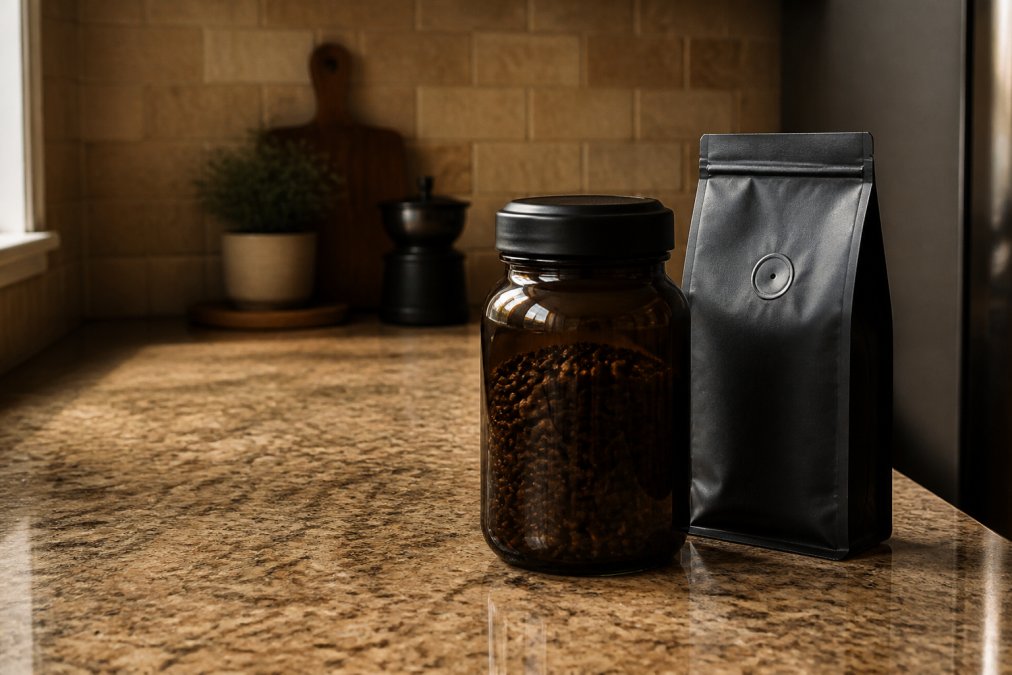
The single most impactful thing you can do is move beans into an airtight container as soon as you open the bag. Exposure to ambient air is the fastest path to staling.
Packaging Technology: One-Way Valves and Airtight Containers
Specialty coffee bags are engineered with a one-way valve, typically found on the front or side of the bag. This valve allows CO₂ released during degassing to escape without letting oxygen in. It is a functional preservation mechanism.
For home storage, an airtight container is the practical standard. Opaque containers are preferable to clear glass because light accelerates lipid oxidation. Ceramic or stainless steel canisters with rubber-sealed lids are the most effective options.
Storage guidelines supported by coffee science:
- Store at room temperature, away from heat sources and direct sunlight
- Never store beans in the refrigerator; moisture and odor absorption risks outweigh temperature benefits
- Freezing whole beans in an airtight, vacuum-sealed container is acceptable for long-term storage, but only if you freeze them once and thaw completely before use
- Buy in quantities you will consume within three to four weeks of the roast date
- Keep beans in whole-bean form until immediately before brewing
As documented in Penn State Extension's food storage science resources, moisture and oxygen are the primary drivers of lipid oxidation in food products, which applies directly to the fats in coffee beans.
What to Do With Stale Coffee Beans
Stale beans are not worthless. The flavor profile is compromised for drinking, but there are practical uses that salvage the investment.
Use them for cold brew. Cold brew's long, slow extraction process at low temperature is more forgiving of stale beans than any hot brewing method. The extended contact time pulls out what remains of the flavor compounds, and the cold water reduces the extraction of bitter notes.
Repurpose as a natural deodorizer. Coffee grounds absorb odors effectively. Place dried grounds in an open container in a refrigerator, pantry, or car to neutralize unwanted smells.
Use as a garden amendment. Coffee grounds are mildly acidic and contain nitrogen, making them useful for compost or as a soil amendment for acid-loving plants.
Make a coffee rub for cooking. Stale beans ground coarsely make a serviceable dry rub for beef, pork, or lamb. The roasted, bitter notes that are unwelcome in the cup complement savory, fatty proteins well.
The most important takeaway is prevention. Buying freshly roasted beans in appropriate quantities, storing them correctly, and knowing how to tell if coffee beans are stale eliminates most waste. When beans arrive days after roasting rather than months, the problem largely solves itself.
According to the USDA's guidance on food quality and storage, proper airtight storage is the most effective consumer-level intervention for slowing oxidative degradation in packaged food products, a principle that applies directly to roasted coffee.
Stale coffee is one of those problems that feels minor until you taste the difference a fresh bean makes. Once you know how to tell if coffee beans are stale, through the bloom test, the aroma check, or the visual surface inspection, you cannot unknow it. American Brew Coffee was built around the conviction that the roast date is everything: every order is roasted the day it is placed and ships from our US facilities within three to five days, so your beans arrive at peak flavor, not past it. With over 40 varieties including single-origin and blended options, there is no reason to settle for the grocery store alternative. Get started with American Brew Coffee and taste what genuinely fresh beans actually deliver.
Frequently Asked Questions
How long does it take coffee beans to go stale?
Whole coffee beans begin losing their best flavor within 2 to 4 weeks after the roast date once the bag is opened and exposed to oxygen. Unopened bags with one-way valve packaging can stay at peak quality for up to 6 to 8 weeks post-roast. Ground coffee stales much faster, often within days, because grinding dramatically increases the surface area exposed to oxidation. Always check the roast date, not just the best-by date, for an accurate read on freshness.
Is it okay to use stale coffee beans, or should I toss them?
Stale coffee beans are safe to drink, they won't make you sick. The problem is purely sensory: oxidation strips away the complex flavor compounds that make a good cup worth drinking, leaving a flat, bitter, or cardboard-like taste. If your beans are mildly past their prime, adjusting your grind size finer or brew ratio slightly stronger can help. Severely rancid beans with an off or sour smell are better repurposed for composting, body scrubs, or odor absorption than brewed.
Can I still use 2-year-old coffee beans?
Two-year-old coffee beans are unlikely to produce a satisfying cup. After that much time, lipid oxidation is extensive, carbon dioxide has fully off-gassed, and the flavor profile will be flat, dull, and often bitter. The beans are not harmful, but the complexity, acidity, and aroma that define quality coffee will be long gone. If freshness matters to you, source beans with a recent roast date, ideally within the past 4 weeks, and store them in an airtight container away from heat and moisture.
What are the main signs that coffee beans have lost their flavor?
The clearest signs of stale coffee beans are a weak or absent aroma when you open the bag, a dull and matte surface with no trace of natural oils, and a flat or hollow taste in the cup with muted acidity. You can also run a bloom test: pour a small amount of hot water over your grounds, fresh beans release visible carbon dioxide bubbles, while stale beans produce little to no bloom. Any hint of a rancid, cardboard, or musty smell is a strong signal the beans are past their best.
This article was written using GrandRanker